.webp)



Waikato, Canterbury, or Southland—it doesn’t matter where you call home; if you’re a Kiwi petrolhead, the goal is the same: building a car that absolute tears up the track on Saturday but can still grab a pie and a coffee on Sunday without a "pink sticker" ruining your mood.
As we look toward the 2026 season, the rules of the game have sharpened. Whether you’re prepping a fresh-off-the-lot platform or finishing a long-term build, navigating the LVVTA (Low Volume Vehicle Technical Association) thresholds is the difference between a clean WOF and a costly headache at the testing station.
At NZShift.co.nz, we’ve crunched the latest data from the LVVTA Modification Threshold Guide to bring you the "Green Light" (WOF-ready) vs. "Red Light" (Cert required) breakdown for your 2026 street-legal track weapon.
Key Takeaways: What You Need to Know
- Suspension: Direct replacement springs are fine; anything with a thread (coilovers) needs a cert.
- Engine Tuning: N/A cars get a 20% power headroom; Turbo/Supercharged cars need a cert for any ECU mapping changes.
- Safety: Seats are okay if they bolt to factory rails; harnesses and airbag deletes are instant "Red Light" territory.
- Ground Clearance: The 100 mm rule remains the golden standard for NZ roads.
When do I need an LVV Cert for suspension?
Suspension is usually the first port of call for any track build, but for 2026 vehicles, the inspectors are looking closer than ever at adjustability.
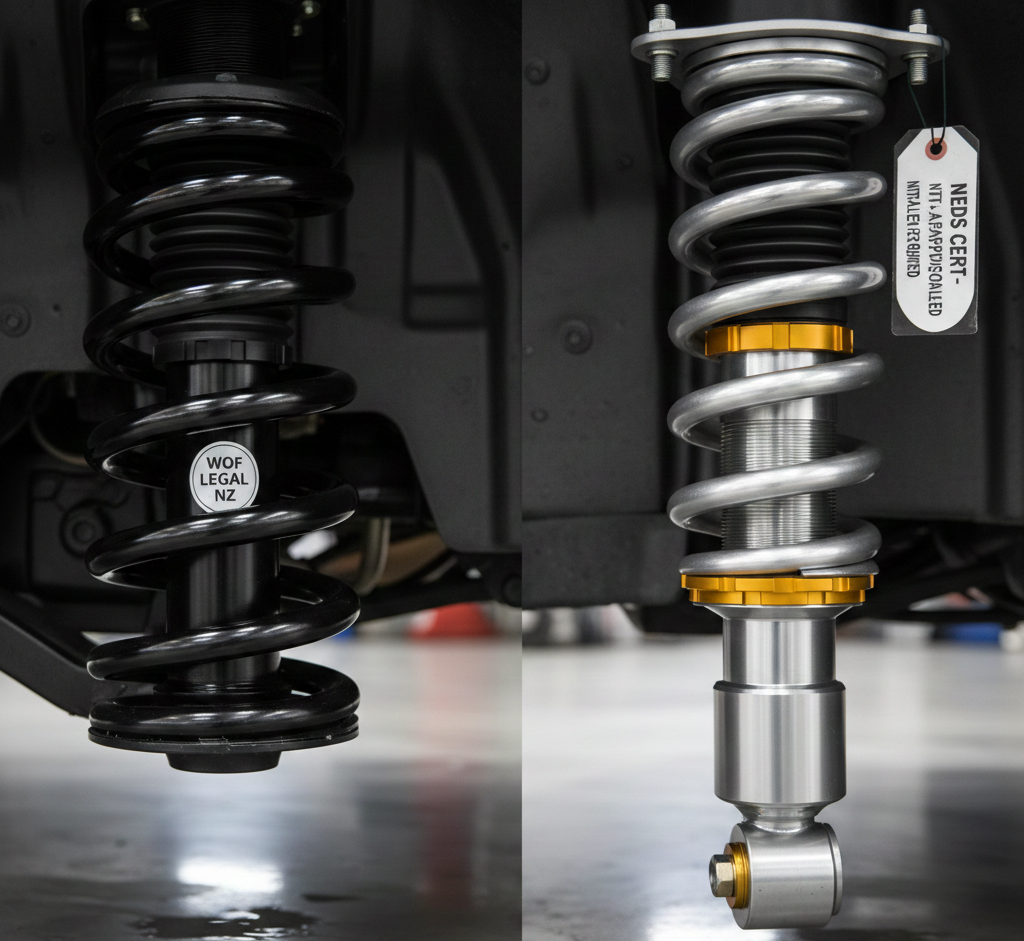
Side-by-side comparison of a WOF-compliant lowering spring and an adjustable coilover requiring an LVV Cert in a New Zealand track car build.
🟢 Green Light (WOF Only)
You can sharpen your handling without an LVV cert if you stick to direct replacements. This means aftermarket springs or shocks that maintain factory geometry and are not height adjustable.
- Captive Springs: Your lowering springs must remain "trapped" in their seats at full droop. No cable ties allowed!
- Sway Bars & Braces: Bolt-on sway bars and strut braces are fine, provided you haven't cut or welded the chassis to fit them.
- Bushings & Alignment: Swapping to polyurethane bushes or using eccentric camber bolts for alignment is permitted.
🔴 Red Light (Needs LVV Cert)
The moment you add a thread to your suspension, you’ve crossed the line. All coilovers (adjustable platforms) require certification. Additionally, replacing factory arms with adjustable camber or toe arms triggers a cert requirement.
Quick Reference: Suspension Mod Status
Non-adjustable Lowering Springs ✅ WOF Only (Green Light)
(Provided they remain trapped at full droop)
Adjustable Coilovers 🔴 LVV Cert Required (Red Light)
(Any height adjustability triggers cert)
Aftermarket Sway Bars (Bolt-on) ✅ WOF Only (Green Light)
(Must use original mounting points)
Strut/Spring Spacers 🔴 LVV Cert Required (Red Light)
(Never WOF legal)
Adjustable Camber/Toe Arms 🔴 LVV Cert Required (Red Light)
(Replacing factory arms requires cert)
Pro Tip: Your car must maintain a minimum of 100 mm ground clearance (unladen) and at least 40 mm of rebound (droop) travel to pass a WOF, regardless of whether it's certified or not.
Does remapping my ECU require an LVV Cert?
This is where the 2026 rules get specific. The "20% Rule" is your best friend or your worst enemy, depending on what’s under the hood.
Naturally Aspirated (N/A) Tuning
If you’re running an N/A setup, you have some breathing room. Minor modifications to fuel injection or ignition systems (including "piggy-back" systems) are WOF-compliant, provided the total power or torque increase is no more than 20% over the original factory spec.
Forced Induction (Turbo/Supercharged)
If your car has a factory hair-dryer, the rules are much stricter. Tuning or "re-chipping" the ECU of a turbocharged or supercharged engine requires an LVV Cert. This includes any software change intended to alter boost pressure, fueling, or ignition timing. Fitting an aftermarket turbo or wastegate is also an automatic "Red Light."
Can I install racing seats and harnesses for track days?
For a 2026 model, the integration of electronics and safety is a major hurdle. Modern "stressed" seats (where the buckle is attached to the seat) make swaps complicated.
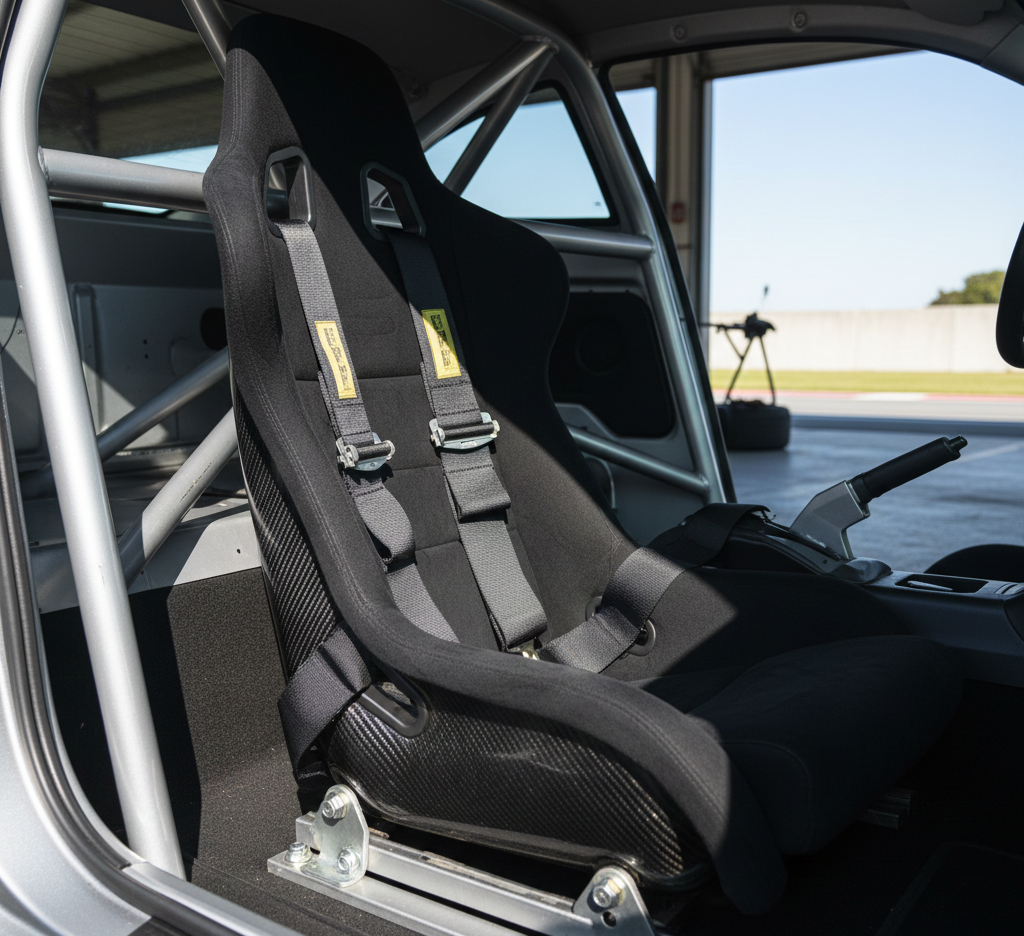
🟢 Green Light (WOF Only)
You can fit "unstressed" aftermarket buckets if they use unmodified OE seat anchorages/rails and do not require the removal or disabling of any airbags.
🔴 Red Light (Needs LVV Cert)
- Harnesses: Installing 4, 5, or 6-point harnesses almost always requires a cert because you are retrofitting new anchorages (like eye bolts or a harness bar).
- Airbags: Removing or disabling any airbag (steering wheel, side, or curtain) requires certification. For a 2026 street car, this is usually only allowed if the vehicle is being purpose-built for motorsport.
- Modified Rails: Any drilling or welding to make a seat fit is an instant cert requirement.
Final Scrutineering
The "Green Light" path is the fastest way to get through your WOF, but if you’re serious about "the pits" and shaving seconds off your lap time, an LVV Cert is often an inevitable part of the journey. It’s an investment in your car's legality and resale value.
Confused about a specific part? If the guide above doesn't cover your specific mod, consider it a "general guideline" and reach out to a local LVVTA certifier before you pick up the spanners.