


If you've stood on the bank at Hampton Downs or Ruapuna and thought "I could do that", good. You probably can. Racing in New Zealand isn't only for people with money or a pro contract, and most of the drivers you're watching started in a car club with a road car.
Here's how you get from the driveway to the grid.
1. Start with ClubSport (no roll cage needed)
Before you start pulling your car apart, know that the grassroots level is ClubSport. It's where nearly everyone in NZ motorsport started.
You don't need a race car. For most ClubSport events you need the M Grade (ClubSport) licence, and for the most basic events you don't even need that.
What the M Grade gets you into. It's the licence for non-racing speed events, where you're against the clock rather than other cars:
- Motorkhana: low-speed tests around cones. The best way to learn car control.
- Bent sprint: a point-to-point time trial.
- Autocross: time trials on grass or gravel.
Use the car you've got. For a lot of these events you can turn up in your daily driver. If it's up to WOF standard you generally don't need a cage. Scrutineers check the basics: battery tied down, a firm brake pedal, nothing loose in the boot or cabin.
The gear. You don't need a race suit to start. For basic ClubSport events, Schedule A usually asks for:
- Overalls: 100% cotton.
- Helmet: one that meets a current approved standard. Check the list before you buy.
- Fire extinguisher: handheld, mounted securely in the car.
2. Stepping up: the C Grade race licence
Once you've done a few sprints and want to race other cars on a circuit, you need the C Grade (National Race) licence. MotorSport NZ defines a circuit race as two or more cars on track at the same time, and that needs at least a C Grade.
Getting it. It isn't a driving test where someone marks your heel-and-toe.
- Apply online: set up a profile on MotorSport Online.
- Sit the exam: an open-book test on the rules and flags. It's about safety, not speed.
Medical. You'll fill in a medical declaration when you apply. If something you declare needs a closer look, it goes to a medical review. Under MSNZ Schedule B (updated 9 October 2026), a review requested by a Medical Assessor costs $50.
3. What it costs to get licensed
Motorsport isn't cheap, but the paperwork side is predictable. These are MotorSport NZ's Schedule B fees, updated 9 October 2026:
- Club membership: varies by club. The 2K Cup South Island club, for example, is $80 per team per year.
- M Grade (ClubSport): $105.
- C Grade (National Race), new: $225 ($250 to renew).
- Participation levy: $82.50 per National Race event, built into your entry fee. It goes up to $86 from 1 January 2027.
4. The cheapest way onto a race grid
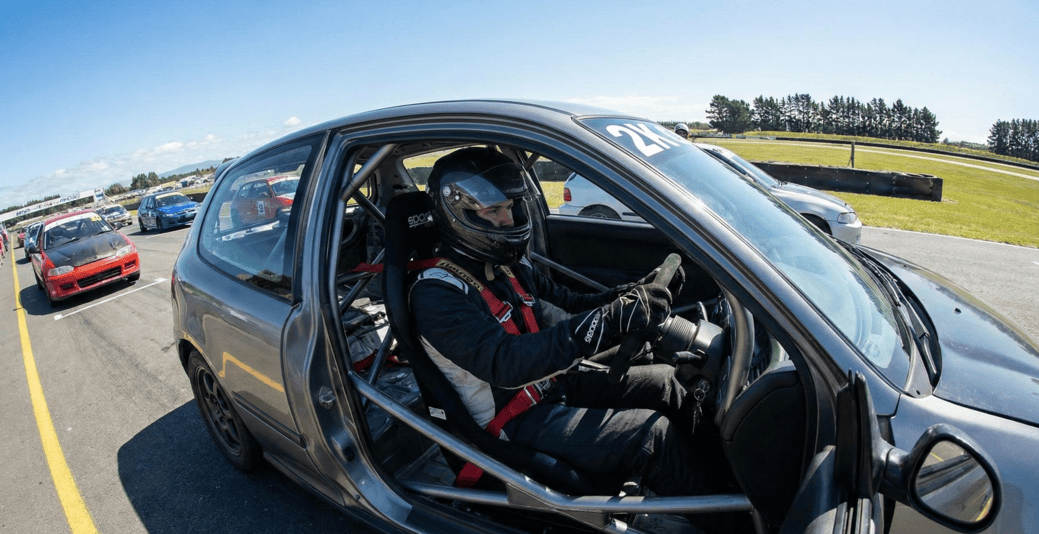
If you want to circuit race without remortgaging, look at the 2K Cup. It's a good example of how budget racing works in NZ.
The idea. In the series' own words, it's "budget racing of standard road cars" at WOF standard with only minimal modifications. Driver skill matters more than spending.
The rules that keep it cheap:
- The car: a mass-produced four-seater that was road legal in NZ when built, 2000cc or less.
- The price: roughly $2000 or less for cars built before 2000, and up to $4000 for cars built after.
- Tyres: no slicks. Everyone runs the control tyre, a road-legal Nankang NS2R.
- No cheating mods: no ECU re-chips or adjustable suspension. Go quicker than the breakout time (for example 1:18.000 at Levels) and you lose points.
The claim rule. To stop anyone spending $10,000 on a "$2000" car, the organisers can buy your car for $2500 after a race if they think you've been cheating. It works.
5. Your first step
Don't wait for the perfect moment. Join a car club.
You can't get a licence without being a member of an affiliated club. The Canterbury Car Club, Northern Sports Car Club or a series club like the 2K Cup South Island will all help you through scrutineering and keep your car going.
Sort your membership, log into MotorSport Online, and find your first event on NZShift. The hardest part is turning up the first time.